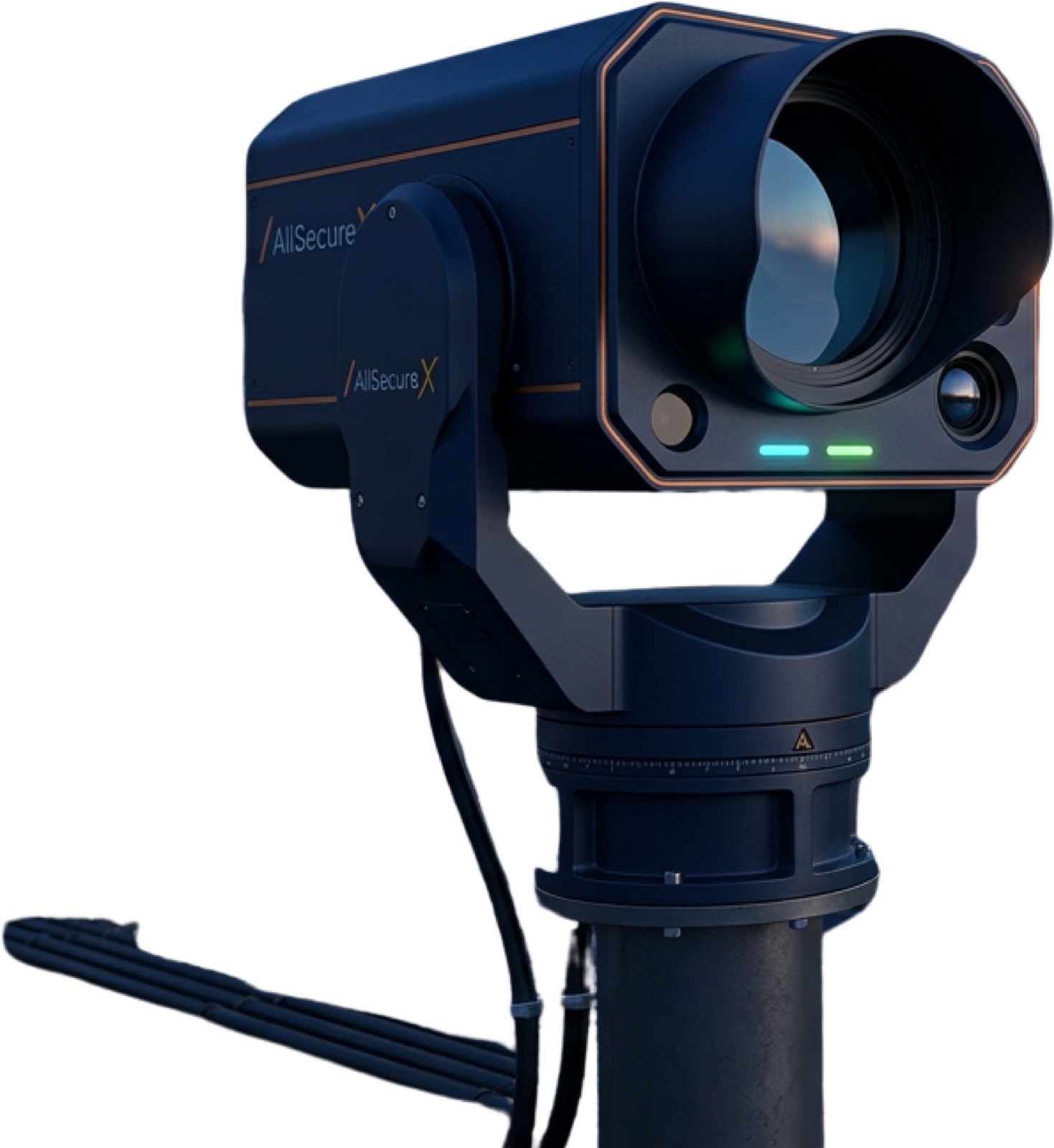
QuantBeam sends your data as an encrypted beam of laser light through open space. No radio to intercept or jam, no fibre to lay, and post-quantum cryptography so even a captured beam yields only ciphertext. Transmission security and communications security, in one sovereign device.

A cryptographically relevant quantum computer will break the RSA and ECC encryption that protects communications today, and adversaries are already harvesting encrypted traffic to decrypt later. QuantBeam is built for that reality: a two-node transmit-and-receive system that encrypts a message on-device with post-quantum cryptography and sends the ciphertext as pulses of a directional laser beam.
Because the message travels only as a narrow beam of light, it emits no radio signal, giving low probability of intercept and detection, it cannot be jammed like radio, and any stray or scattered light an adversary captures is only ciphertext. It needs no fibre trenching, works across line-of-sight in difficult terrain and dense urban areas, and runs on commodity, indigenous hardware, fully air-gapped.
QuantBeam complements radio, fibre and national Quantum Key Distribution programmes rather than competing with them, and can even provide the post-quantum authentication that QKD deployments require.
QuantBeam uniquely combines transmission security (a hard-to-find, hard-to-jam optical beam) with communications security (post-quantum confidentiality, authentication and integrity). Explore how each layer works.
The transmitter switches a directional laser on and off to send information as pulses of light through open air. A photodiode at the receiver reads the pulses and reconstructs the message. There is no antenna and no radio-frequency emission.
Every message is encrypted on-device before it ever leaves as light, using NIST-standardised post-quantum algorithms, so the content is protected against both classical and quantum attackers.
Cryptography is only as strong as its randomness. QuantBeam seeds its key generation from a multi-source quantum-entropy source, the same lineage as our Qentropy appliance, for high-assurance, unpredictable keys.
No radio signature at all. The link cannot be located, intercepted or jammed by conventional radio-frequency means.
ML-KEM-1024 and AES-256-GCM on every message, with optional ML-DSA signing for authenticity.
A narrow line-of-sight beam is inherently hard to tap; there is no broadcast for an adversary to capture.
Establish a secure link across a base, a valley or a city block in hours, with no cabling.
Indigenous, low-cost electronics. No exotic quantum optics or trusted nodes required to operate.
Works alongside national Quantum Key Distribution efforts and can provide their post-quantum authentication layer.

The transmitter encrypts your message with post-quantum cryptography and, optionally, signs it. Plaintext never leaves the device.
A directional laser is switched to send the ciphertext as pulses of light across open, line-of-sight space, with no radio emission.
The far-end photodiode reads the light and the receiver decrypts and verifies the message. Any intercepted light is only ciphertext.
Radio-silent links between command posts, bunkers, forward positions and vehicles across line-of-sight in EMCON and electronic-warfare-contested environments.
Emission-free links between buildings, across a perimeter or a base, without laying fibre.
Rapid secure links where fibre is impractical or slow, and where radio would reveal presence.
Links between control rooms and across substations, plants and campuses that must stay emission-free.
Secure inter-building communication in sensitive facilities where radio is restricted.
Short-range secure downlinks for UAV and ground control, and shore-to-ship and ship-to-ship optical links.
Indicative, marketing-level specifications. Full technical specifications are shared under briefing.
| Communication medium | Free-space optical (directional laser / Li-Fi), line-of-sight |
| Emissions | None (no radio-frequency signature) |
| Key encapsulation | ML-KEM-1024 (NIST FIPS 203) |
| Bulk encryption | AES-256-GCM |
| Authentication | Optional ML-DSA signatures (NIST FIPS 204) |
| Entropy source | Multi-source quantum-entropy seeding |
| Topology | Paired transmitter and receiver nodes |
| Connectivity | Fully air-gapped; no internet or spectrum licence required |
| Hardware | Commodity indigenous electronics, no dedicated crypto chip |
| Origin | Sovereign Indian IP, developed under senior defence advisory |
No. QKD needs specialised quantum hardware, dedicated fibre and trusted nodes. QuantBeam runs on commodity, indigenous hardware today, secures the payload with NIST-standardised post-quantum cryptography, and transmits it over a free-space optical beam. It complements QKD and can even provide the post-quantum authentication that QKD deployments require.
The link is a narrow, directional, line-of-sight beam with low probability of intercept and detection, so it is inherently hard to find and tap. Crucially, even if an adversary captures scattered or stray light, it decrypts to nothing but ciphertext, because every message is post-quantum encrypted on-device before transmission.
None. Data travels only as pulses of light, so there is no radio-frequency emission to intercept, jam or direction-find. This supports emission-control (EMCON) requirements where radio would reveal position.
Neither. QuantBeam is a paired transmitter and receiver that works across open, line-of-sight space with no cabling, and operates fully air-gapped with keys generated and stored on-device.
Request a briefing or a field demonstration of quantum-safe communication over light, tailored to your operational environment.
Request a Briefing